
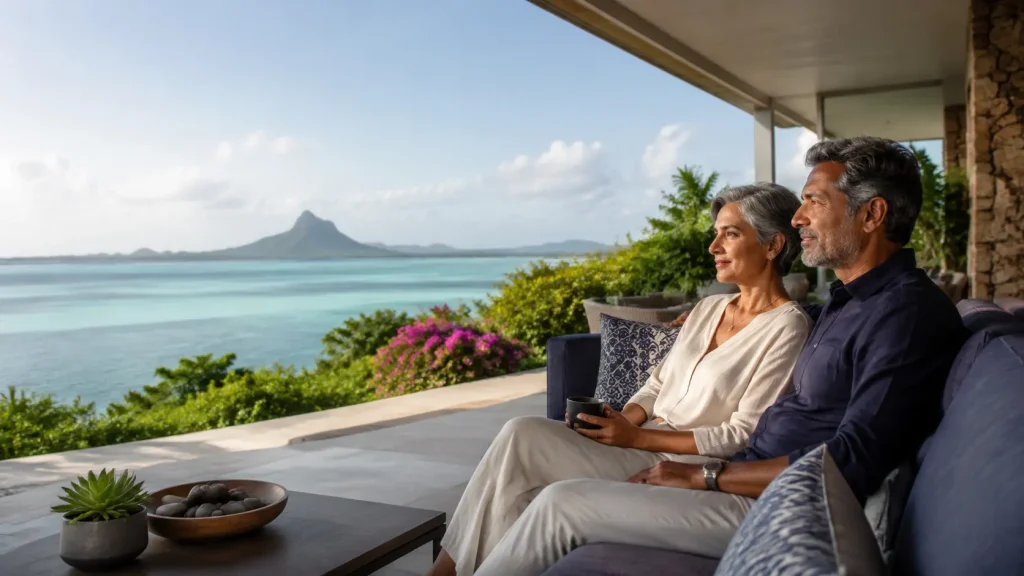
Mauritius offers an attractive retirement destination for foreign nationals seeking a secure, internationally connected and comfortable place to live. Beyond its tropical climate and beaches, the country provides modern private healthcare, political stability, established banking services and a multicultural society in which both English and French are widely used.
Foreign nationals aged 50 or above may apply for a Retired Non-Citizen Residence Permit. The permit can be granted for up to ten years, may be renewed subject to the applicable conditions and can also provide a route to longer-term residence.
This guide explains the principal eligibility requirements, financial obligations, application process and practical considerations for retiring in Mauritius.
Important: Immigration requirements, statutory fees and administrative procedures may be amended. Applicants should verify the rules applicable on the date of submission and obtain advice based on their personal circumstances.
What Is the Mauritius Retirement Residence Permit?
The Retired Non-Citizen Residence Permit allows a qualifying foreign national to reside in Mauritius as a retiree.
Although it is often informally called the “Mauritius retirement visa,” it is legally a residence permit rather than an ordinary visitor visa. It is generally issued for a maximum period of ten years and is renewable where the holder continues to satisfy the prescribed conditions.
An application may be initiated online from outside Mauritius through the National Electronic Licensing System. Following approval in principle, the applicant must complete the remaining formalities, including presenting original documents and satisfying the medical and financial requirements.
Who Is Eligible?
The principal applicant must be at least 50 years old when applying.
The applicant must also demonstrate access to sufficient funds. Under the presently published criteria, this may be shown through:
- A guaranteed income of at least USD 2,000 per month; or
- A bank statement showing available funds of at least USD 24,000.
The supporting bank statement should ordinarily come from the applicant’s country of origin or country of residence.
After obtaining the permit, the retiree must comply with the continuing foreign-funds transfer requirements. Evidence of transfers may be required for monitoring and renewal purposes. The current criteria should therefore be checked immediately before the application is filed.
Main Features of the Retirement Permit
| Requirement or benefit | Current general position |
|---|---|
| Minimum age | 50 years |
| Initial permit duration | Up to 10 years |
| Renewal | Permitted, subject to satisfying the applicable criteria |
| Financial evidence | USD 2,000 monthly income or USD 24,000 in available funds |
| Physical-presence requirement | No prescribed minimum period of residence after the permit is granted |
| Dependants | Eligible family members may apply for dependent residence permits |
| Investment | Permitted, subject to restrictions governing employment and benefits |
| Longer-term residence | A 20-year permit may be available if the relevant conditions are met |
Can Family Members Accompany the Retiree?
Eligible dependants may apply for residence permits linked to the principal permit holder. Depending on the prevailing rules and the circumstances of the family, this may include:
- A spouse;
- An eligible partner;
- Children or stepchildren within the prescribed age limits; and
- Parents of the principal permit holder.
Each dependent application is assessed separately. Civil-status documents—such as birth, marriage, adoption or divorce certificates—may have to be authenticated, translated into English or French and submitted in their original form.
A dependant’s permit will not normally extend beyond the validity of the principal holder’s permit. The Passport and Immigration Office confirms that dependants of retired residence-permit holders may apply for residence for a corresponding period.
Is There a Minimum Stay Requirement?
A notable feature of this permit is the absence of a prescribed minimum number of days that the holder must spend in Mauritius merely to retain the retiree status.
This can make the permit suitable for individuals who divide their time between Mauritius and another country. However, immigration residence and tax residence are different concepts. A person may hold a Mauritian residence permit without automatically becoming tax resident in Mauritius.
Tax residence commonly depends on factors such as the number of days spent in the country, domicile and the individual’s pattern of residence over several income years. The Mauritius Revenue Authority explains that foreign income received by a tax-resident individual may be taxable when derived in or remitted to Mauritius. Mauritius Revenue Authority guidance
Professional tax advice should therefore be obtained before transferring pensions, investment income or other substantial foreign earnings.
May a Retired Non-Citizen Work or Invest?
A retiree residence permit should not be treated automatically as an unrestricted employment authorisation.
A retired permit holder may generally invest in a Mauritian business, provided that the person is not employed by that business and does not receive a salary or employment benefits from it. Passive investment, share ownership and active employment must therefore be distinguished carefully.
Legislative and policy changes have also been proposed or introduced concerning the ability of retired residents to undertake employment. Anyone intending to work locally, manage a business or provide services from Mauritius should obtain confirmation that the proposed activity is lawful under the rules in force at that time.
Remote work for an overseas employer or foreign clients may also create immigration, tax, social-security or business-registration consequences. The proper structure depends on the nature of the work rather than simply on where the client is located.
Pathway to a 20-Year Residence Permit
A retired non-citizen may eventually qualify for a 20-year Permanent Residence Permit.
Under the criteria currently published on the official residency portal, an applicant under the retired category must ordinarily:
- Have held a Retired Non-Citizen Residence Permit for at least five years; and
- Have transferred an aggregate of at least USD 200,000—or its equivalent in freely convertible currency—to Mauritius during the relevant five-year period.
The transfers may be made by instalments or through another acceptable arrangement, provided the required aggregate amount and evidential requirements are satisfied.
Because older government publications may display different qualifying periods or financial thresholds, applicants should rely on the criteria effective when they become eligible to apply.
Documents Commonly Required
The exact documentation depends on the applicant’s nationality, immigration history and family circumstances. A typical application may require:
- A valid passport;
- A full birth certificate;
- A recent certificate of character or police clearance covering the required period;
- Recent passport-format photographs meeting the stated digital specifications;
- Bank statements or evidence of guaranteed monthly income;
- A signed undertaking in the prescribed form;
- Marriage, divorce or other civil-status documents, where applicable;
- Medical certificates and test results issued within the accepted period;
- Evidence of the applicant’s most recent entry into Mauritius; and
- Documents relating to any existing Mauritian visa or permit.
Documents that are not in English or French will generally require a certified or sworn translation. Originals must normally be presented during the appointment stage.
Minor inconsistencies between a passport, birth certificate, bank record and civil-status document can result in queries or delays. Names, dates of birth and other identifying details should therefore be checked carefully before submission.
How to Apply
1. Review eligibility and immigration history
Before submitting an application, the applicant should confirm that the age and financial requirements are met. Previous visa refusals, overstays, criminal matters or inconsistent civil-status records should be addressed at this stage.
2. Collect and review the supporting documents
Police clearances, birth certificates and bank records should comply with the prescribed format and validity periods. Translations and certifications should be completed by competent persons or authorities.
3. File the online application
The initial application is made through the Government’s National Electronic Licensing System. Applicants can generally begin this process from abroad.
4. Obtain approval in principle
The relevant authorities examine the application and may request explanations or additional evidence. Approval in principle does not dispense with the remaining requirements and should not be confused with the final residence permit.
5. Complete the post-approval requirements
The applicant may have to travel to Mauritius, open a local bank account, undergo the required medical examinations and upload updated documents. The timing of travel should be coordinated with the conditions stated in the approval letter.
6. Attend the official appointment
Original documents are presented for verification. The authorities may also confirm the applicant’s identity, immigration status, medical results and evidence of funds.
7. Pay the applicable statutory charges
The required government charges must be paid before the permit is issued. Applicants should retain receipts and copies of the final permit documentation.
Application Fees and Other Expenses
The official EDB retirement page currently lists a statutory permit fee of USD 1,000 for a successful principal applicant. In addition, a non-refundable application fee of USD 50 has applied to occupation-permit and retired-residence-permit applications since 1 December 2025.
Separate charges may arise for dependants and for:
- Police-clearance certificates;
- Medical examinations;
- Certified translations;
- Authentication or legalisation of foreign documents;
- Bank-account formalities; and
- Professional assistance.
Government charges should always be confirmed immediately before submission, particularly where several family members will be applying.
Taxation of Foreign Pensions and Income
Mauritius is often described as offering an attractive tax environment, but a residence permit does not create an automatic exemption from tax.
The treatment of a foreign pension or other overseas income may depend on:
- Whether the person is tax resident in Mauritius;
- Whether the income is remitted to Mauritius;
- The source and legal nature of the income;
- The provisions of the relevant double-taxation agreement; and
- Any exemption, credit or relief available under Mauritian law.
Tax planning should ideally take place before the retiree becomes resident or transfers substantial funds. Advice may also be required in the country from which the pension or investment income originates.
Choosing Where to Live in Mauritius
Each region offers a different retirement experience.
Grand Baie and the North
The north is popular with foreign residents because of its restaurants, shopping centres, private clinics, beaches and active social life. Grand Baie is convenient and cosmopolitan, although accommodation can be more expensive than in less developed regions.
Tamarin and Black River
The west coast is known for its relatively dry climate, mountain scenery and outdoor lifestyle. It appeals particularly to retirees interested in walking, swimming, boating and other recreational activities.
Flic-en-Flac
Flic-en-Flac combines a long public beach with supermarkets, restaurants and a substantial expatriate community. It may offer a useful balance between coastal living and access to the central part of the island.
Moka and the Central Plateau
Moka provides a cooler inland climate, modern amenities and convenient access to business districts and private healthcare. It may suit retirees who prefer a quieter residential setting to a tourist-oriented coastal area.
Mahébourg and the Southeast
The southeast offers a more traditional and peaceful environment. It may appeal to those seeking a slower pace of life, although access to certain specialist services can require additional travel.
Before entering a long lease or purchasing property, it is sensible to stay in the preferred area temporarily and assess traffic, healthcare access, climate and day-to-day amenities.
Can a Foreign Retiree Purchase Property?
A retired residence permit does not, by itself, allow unrestricted acquisition of every category of Mauritian immovable property.
Non-citizens may acquire qualifying residential property under approved schemes and in certain authorised developments or apartment buildings, subject to the Non-Citizens (Property Restriction) Act and any required approvals. Some qualifying property acquisitions can also provide an independent route to residence.
Legal due diligence should be completed before signing a reservation form, preliminary agreement or deed. The purchaser should verify:
- Whether the property may legally be acquired by a non-citizen;
- Whether government authorisation is required;
- The developer’s title and approvals;
- Taxes, registration duties and notarial charges;
- Management and syndicate obligations; and
- Whether residence rights are attached to the acquisition.
Retiring in Mauritius from South Africa
Mauritius is particularly attractive to South African retirees because of the relatively short flight, limited time difference and established South African community.
The general retirement-permit criteria remain the same, but South African applicants should also consider:
- Exchange-control and foreign-transfer arrangements;
- The tax treatment of pensions and investments under the Mauritius–South Africa Double Taxation Agreement;
- Whether their existing medical cover applies outside South Africa;
- Estate planning and the location of their assets; and
- The tax consequences of changing residence.
These issues should be reviewed by appropriately qualified advisers in both jurisdictions.
How SK Adheen Chambers Can Assist
Applying for a residence permit involves more than uploading a collection of documents. The legal basis of the application, the applicant’s immigration history and the accuracy of the supporting evidence can all affect the outcome.
SK Adheen Chambers can assist foreign retirees and their families with:
- Assessing the appropriate residence pathway;
- Reviewing immigration and civil-status documents;
- Identifying potential difficulties before submission;
- Preparing representations or explanations where necessary;
- Advising on dependent applications;
- Providing guidance on lawful property acquisition by non-citizens;
- Reviewing leases, reservation agreements and property transactions; and
- Coordinating with tax, banking, medical and other professionals where specialist assistance is required.
Frequently Asked Questions
What is the minimum age for the Mauritius retirement permit?
The principal applicant must be at least 50 years old.
How long is the permit valid?
It may be issued for a maximum period of ten years and can be renewed if the relevant conditions continue to be satisfied.
Must I live in Mauritius throughout the year?
There is presently no prescribed minimum period that a retiree-permit holder must spend in Mauritius. However, physical presence remains relevant to tax residence and other legal matters.
Can my spouse accompany me?
An eligible spouse may apply for a dependent residence permit. Supporting marriage and identity documents will be required.
Does the permit automatically make me a Mauritian tax resident?
No. Immigration residence and tax residence are determined under different rules.
Can I buy a house anywhere in Mauritius?
No. Property acquisition by non-citizens is regulated. The property and proposed transaction must fall within a legally permitted category and may require government approval.
Does the permit lead automatically to citizenship?
No. A residence permit, including a long-term permit, does not automatically confer Mauritian citizenship.
Conclusion
The Retired Non-Citizen Residence Permit offers qualifying foreign nationals a structured route to establish a home in Mauritius for up to ten years. Its combination of a relatively accessible age threshold, renewable residence and the possibility of longer-term status makes it an appealing option.
Nevertheless, applicants should not rely only on general online summaries. Financial thresholds, fees, employment rights and permanent-residence criteria can change, while tax and property rules depend heavily on individual circumstances.
For advice concerning retirement residence, dependent permits or relocation-related legal matters in Mauritius, contact SK Adheen Chambers for an assessment of your circumstances.
Information checked against official sources available on 19 August 2026. This article provides general information and does not constitute legal or tax advice. Retiring in Mauritius offers a unique opportunity for individuals seeking a tranquil lifestyle in a picturesque environment. The Mauritius retirement residence permit facilitates this transition, allowing retirees to enjoy the benefits of living in this idyllic location. To obtain the Retired Non-Citizen Residence Permit Mauritius, applicants must meet specific Mauritius retirement visa requirements, which include proof of sufficient income and health insurance. Overall, retirement residency in Mauritius presents an attractive option for those looking to embrace a new chapter in their lives.