
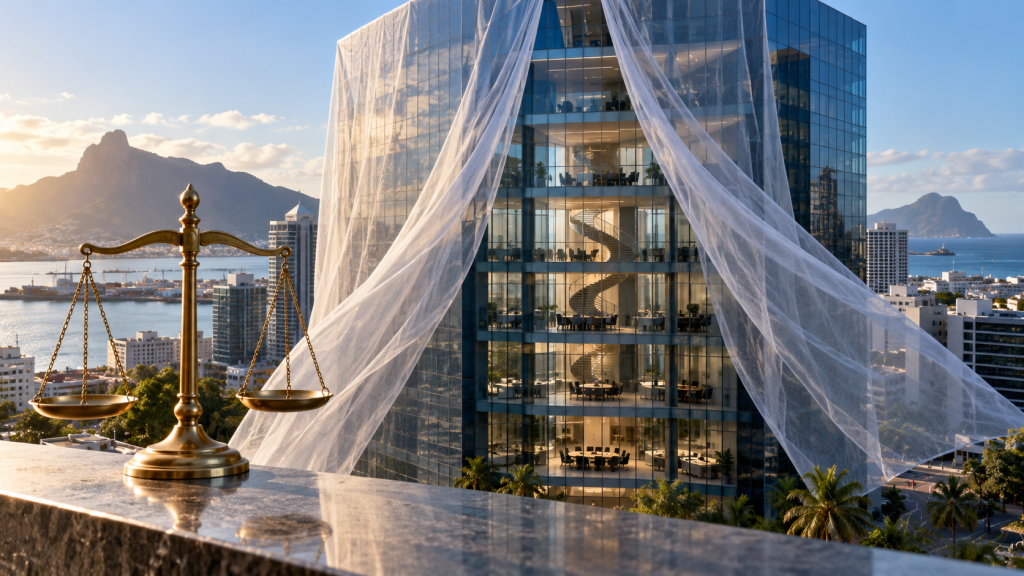
Every company incorporated in Mauritius has its own legal personality. Whether it is a small hospitality business operating in Grand Baie or a Global Business Company used to channel investment into Africa or India, the company exists in law independently of its shareholders, directors and founders.
This principle, commonly known as the “corporate veil” or “veil of incorporation”, is a cornerstone of modern company law. It allows individuals to conduct business through a separate legal entity and generally limits their personal exposure to the liabilities of that entity. It also plays an important role in maintaining Mauritius’s attractiveness as an international financial and investment jurisdiction.
However, the protection afforded by incorporation is not absolute. Difficulties arise when the corporate structure is used dishonestly—for example, where a director relies on the company’s separate personality to avoid an existing debt, conceal wrongdoing or move assets beyond the reach of creditors.
In exceptional circumstances, the courts may look beyond the company’s separate legal identity and impose liability on the individuals or entities controlling it. This is generally referred to as “lifting” or “piercing” the corporate veil.
Although the doctrine is applied sparingly, it remains one of the most significant safeguards against misuse of the corporate form in Mauritian commercial law.
An English principle developed through Mauritian case law
The starting point remains the landmark English decision in Salomon v A Salomon & Co Ltd [1897]. The case established that, once a company has been validly incorporated, it acquires a legal personality distinct from that of its shareholders—even where one person owns and controls nearly the entire business.
Mauritian courts have consistently recognised this principle. Accordingly, the liabilities of a company are not ordinarily treated as the personal liabilities of its directors or shareholders. Any departure from the company’s separate personality must therefore remain exceptional.
Mauritius does not presently have a single statutory framework comprehensively defining the circumstances in which the corporate veil may be pierced. The doctrine has instead developed through judicial decisions, with Mauritian courts frequently considering English authorities such as Adams v Cape Industries plc, which adopted a restrictive approach to disregarding corporate personality.
Several Mauritian judgments have helped shape the local position.
In Maudar and Others v Moirt and Others (2011 SCJ 387), the Supreme Court undertook a substantial examination of the doctrine and its possible application in Mauritius.
The Court of Civil Appeal later considered the issue in Barahim M F v Transinvest (Mauritius) Ltd (2013 SCJ 418). Despite the involvement of a company director in circumstances connected with a construction debt, the Court declined to disregard the separate personality of the property development company. The evidence did not reveal conduct sufficiently improper or suspicious to justify such an exceptional intervention.
The importance of Barahim lies partly in what the Court refused to do. The judgment demonstrates that ownership, control or involvement in a company’s affairs will not, without more, make a director personally liable for the company’s obligations.
The doctrine was considered again in Mauritius Post and Co-operative Bank Ltd v Triolet Multipurpose and Agro-Mechanical Co-operative Society Ltd and Others (2014 SCJ 290).
In Mohung A v Murday D (2016 SCJ 330), the Supreme Court further explained that lifting the corporate veil should not necessarily be approached as a rigid legal rule based on an exhaustive list of conditions. It is better understood as a judicial exercise requiring a careful examination of the particular facts and circumstances of each case.
The Mauritian position is therefore cautious and highly fact-sensitive. The courts will not disregard corporate personality merely because doing so might produce a fairer result for one of the parties.
Why the doctrine is particularly important for Mauritius
Piercing the corporate veil is not simply an academic topic. It has practical importance for a jurisdiction that has spent decades developing itself as a platform for international investment and cross-border corporate structuring.
Mauritius’s position as an international financial centre depends upon maintaining an appropriate balance between two competing considerations.
On the one hand, legitimate investors and entrepreneurs require certainty. They must be able to rely on the principle that a company’s obligations ordinarily remain with the company. Without that assurance, the commercial value of limited liability would be significantly weakened.
On the other hand, the law must prevent individuals from using companies as instruments of fraud, concealment or evasion. A person should not be permitted to establish an empty corporate shell, use it to incur liabilities or commit wrongdoing, and then avoid accountability merely because the relevant acts were carried out through a company.
If courts pierce the veil too readily, commercial certainty suffers and investors may become reluctant to use Mauritian structures. If they apply the doctrine too narrowly, the corporate form may become a shield for abuse.
Mauritian courts have generally favoured restraint. That approach protects the integrity of separate corporate personality, but it also raises an important policy question: is the present threshold sufficiently responsive to the complexity of modern domestic and cross-border corporate arrangements?
Concerns identified by legal scholarship
The limitations of the present framework have increasingly attracted academic attention.
A study published in the Journal of Financial Crime in 2021 considered veil-piercing in the context of corporate environmental wrongdoing. It reportedly identified an absence of specific Mauritian legislation—and little or no local judicial authority—recognising environmental harm as an independent basis for disregarding corporate personality.
For an island economy heavily dependent on its coastline, marine environment and tourism sector, this is not a purely theoretical concern. The environmental and accountability issues exposed by the 2020 Wakashio oil spill demonstrated how difficult questions of corporate responsibility can arise where operations involve several companies, contractors and entities established across different jurisdictions.
A comparative study published in the International Journal of Law and Management in 2024 examined the Mauritian and United Kingdom approaches. It concluded that notable weaknesses remain in Mauritius’s legislative treatment of corporate offences, particularly because the courts may lift the veil only in narrowly defined and exceptional circumstances.
The study recommended legislative intervention rather than continued reliance on the slow and uncertain development of the doctrine through a relatively small body of case law.
Protecting limited liability while preventing abuse
The answer is not to weaken the principle of separate corporate personality.
Limited liability is not inherently a legal loophole. It is a legitimate and necessary commercial mechanism. It encourages entrepreneurship, allows individuals to undertake calculated business risks and contributes to the confidence of foreign investors using Mauritian corporate structures.
A corporate veil that could be pierced whenever a company could not satisfy its debts would cease to offer meaningful protection. Directors and shareholders would face uncertainty each time a business failed or a commercial venture produced an unfavourable result.
At the same time, limited liability should not become immunity from accountability. The law must remain capable of responding where a company is deliberately used to conceal fraud, defeat existing legal obligations or frustrate the lawful claims of creditors.
The real issue is therefore one of balance. Mauritius must preserve the legal certainty that supports investment while ensuring that incorporation cannot be exploited as a device for wrongdoing.
Is legislative reform now necessary?
Mauritius continues to present itself as a well-regulated and credible international financial centre. Yet its law on piercing the corporate veil remains largely dependent upon a limited number of judicial decisions, many of which apply principles inherited from English law.
Meanwhile, corporate groups, international financial transactions and asset-holding arrangements are becoming increasingly sophisticated. The legal risks associated with environmental harm, insolvency, financial crime and cross-border enforcement have also evolved considerably.
Clear legislation could provide greater certainty by identifying the exceptional circumstances in which courts may disregard separate corporate personality. Properly drafted reform would not undermine legitimate companies or expose directors and shareholders to routine personal liability. Instead, it could establish a more predictable framework for distinguishing genuine commercial activity from deliberate abuse.
The corporate veil remains essential to Mauritian company law and should continue to be strongly protected. Nevertheless, that protection must not be allowed to become an impenetrable barrier to justice.
For Mauritius, the challenge is not to choose between limited liability and accountability. It is to preserve both through a framework that reflects the realities of modern commerce. The growing academic consensus suggests that relying exclusively on cautious, case-by-case judicial development may no longer be sufficient—and that carefully designed legislative reform deserves serious consideration.